MIR corpus
MIR: The Thermodynamics of Meaning
1. Introduction: Two Lines of Order and the Breath of Life
Creation is not magic. It is thermodynamics — and you are both the engine and the fuel.
The world we live in is not a static backdrop — it is perpetual motion. Any engineer knows that stability is merely a special case of dynamics, when a system temporarily reaches equilibrium.
In the first part of the “MIR” model we described the roles of the participants: Creator, Educator, Provocateur, Curator. Now we turn to the engine of reality itself — the mechanics that set these roles in motion.
At the center lies the process of crystallization — the transformation of primary, unformed energy (Chaos) into stable structure (Order). But there is a crucial nuance: crystallization is not a one-sided act of creation. It is a two-way process of measurement.
In quantum physics, measurement is an interaction that inevitably changes both the object and the observer. The instrument’s needle moves; memory is rewritten.
We use this as a working metaphor — not as a literal description of the micro-world, but as a conceptual tool that allows us to formulate the fundamental law of the model:
You cannot bring order to Chaos without changing yourself.
Two Lines of Order
Crystallization unfolds along two parallel paths:
- Automatic Order (the laws of physics) This is the Universe’s “base firmware.” Chaos transforms into matter, stars, and planets automatically, following algorithms established by the Creator. This foundation is reliable, predictable, and requires no participation from us.
- Creative Order (the work of Consciousness) Here, automatism ends and freedom begins. Consciousness takes the ready-made “building blocks” of the physical world and rearranges them into something new: meanings, ideas, technologies, relationships.
The Cycle of Life: Inhalation and Exhalation
Life — whether individual, social, or cosmic — is a pulsation:
- Inhalation is crystallization: energy condenses into Order.
- Exhalation is dissolution: forms outlive their usefulness and return to Chaos as pure resource.
We tend to view destruction as tragedy and order as absolute. But in an engineering model of the universe, these are simply two phases of a single engine. Without Chaos there is no material for creation. Without Order, energy remains unusable.
What This Article Is About
We will explore how Consciousness navigates between these phases — why it is simultaneously a student at its own level of reality and raw material for higher ones. And how to learn to see Chaos not as a threat, but as an opportunity for the next evolutionary step.
In the sections that follow, we will examine the four pillars of existence (Chaos, Order, Consciousness, Harmony), the mechanics of crystallization, the recursive nature of consciousness, the role of entropy, and the energetic cost of creation.
2. The Four Pillars of Existence: The Anatomy of Resource and Form
To understand how the engine of reality operates, we must break it down into its fundamental components. In the MIR model, everything that exists can be described through four core entities. These are not “things,” but states or roles that energy assumes during the process of crystallization.
2.1. Chaos: The Ocean of Superposition
Chaos is not “disorder” in the everyday sense — it is pure potential.
From an engineering perspective, it is like a warehouse where everything exists, but nothing has yet been assembled. It is energy in the state of “it could become anything.”
- Property: Chaos contains all possible outcomes simultaneously. It is infinite, impersonal, and has no internal structure.
- Function: It serves as raw material. Chaos itself has no inherent meaning, yet it is the source of all life, ideas, and actions.
Without Chaos, there is nothing to crystallize. It is the ocean from which Consciousness catches the “fish” of Order.
2.2. Order: A Fixed Form
Order is Chaos that has “collapsed” into a specific state. It provides the stability necessary for both matter and thought. However, not all Order is the same.
- Foundational Order (Hardware): The laws of physics, chemistry, and gravity. This is automatic crystallization initiated by the Creator. It forms the “stage” — atoms, stars, planets, cells — and operates independently of our involvement.
- Order-as-Meaning (Software): The product of Consciousness: ideas, algorithms, narratives, social systems, technologies. These are temporary “frozen” forms that persist only as long as energy — attention, interest, belief — flows through them. Once that flow stops, they begin to disintegrate.
Key point: Every form of Order — physical or conceptual — has a limited lifespan. This is what distinguishes it from Chaos, which is eternal.
2.3. Consciousness: The Final Observer
Consciousness is the active element of the system — the only force capable of transforming “maybe” into “is.”
- The act of measurement: When Consciousness focuses on Chaos, it performs an act of selection. Infinite probabilities collapse into a single form of Order. Thinking is not passive — it is an act of creation.
- The price of change: The observer cannot remain unchanged. By shaping Order in the world, you simultaneously reshape yourself. Every decision rewrites your internal structure.
You are the sum of your choices — and the meanings you have brought into existence.
- Dual role: Consciousness functions both as architect (organizing Chaos) and as material (becoming part of Order for higher systems). This duality will be explored further in Section 4.
2.4. Harmony: The Mathematics of Optimality
Harmony is neither subjective preference nor aesthetic ideal. It is the principle of least action applied to the space of meaning.
- Function: Among countless possible ways to organize Chaos, Harmony identifies the path that requires minimal energy while producing maximal effect. It is the “golden ratio” of reality.
- Role: Harmony acts as a guiding signal. Consciousness naturally seeks it — whether consciously or not — because only in Harmony can systems function without overheating, friction, or drift.
- Connection to the model: Harmony is the method of the Educator and the benchmark used by the Curator (the ideal future self) to guide correction.
Section Summary
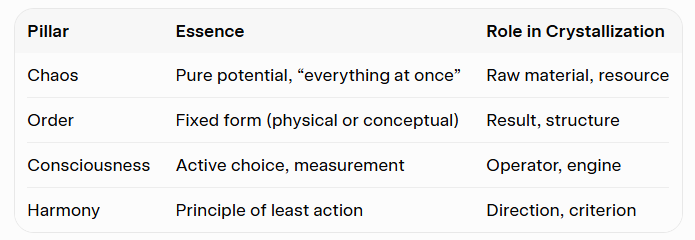
In the following sections, we will examine how these four pillars interact in the process of crystallization, why Order inevitably decays, and what price Consciousness pays for every act of creation.
3. Crystallization: The Two-Way Dance of Creation
Crystallization is the central working process of the MIR model — the moment when Chaos (pure potential) turns into Order (stable form) under the influence of Consciousness.
In simple terms, it is creation in its broadest sense: from the birth of an idea to building a house, from making a decision to writing a story. But crystallization is not a sudden flash of inspiration. It has stages, tools, and an energetic cost. Let’s examine them step by step.
3.1. Pre-Crystallization: Creating Condensation
Before Chaos hardens into a solid structure, a phase of energetic condensation occurs. Consciousness does not strike blindly — it first creates tension within Chaos.
- The informational embryo: By directing intention into the ocean of possibilities, Consciousness begins to “magnetize” energy around a chosen point. Chaos stops being uniform noise; a probability gradient appears. Some outcomes become far more likely than others.
- The waiting zone: A region of increased density forms — an “information matrix,” the embryo of future Order. The idea already carries weight, but it has not yet taken tangible form.
- Energy conservation: This preparatory phase reduces the risk of overload. Once meaning reaches critical density, crystallization unfolds almost automatically — like a crystal forming in a supersaturated solution. This minimizes destructive recoil.
3.2. Collapse and Recoil
At peak density, collapse occurs: uncertainty disappears, and one outcome becomes reality.
But this process has two important consequences:
- The cost of change: Chaos resists fixation. The moment Order forms, Consciousness experiences recoil — an energetic backlash, like the vibration felt by a blacksmith with each strike.
- The observer is rewritten: The act of creation changes the creator. Memory, neural patterns, and decision-making structures are updated. We do not simply create reality — we reconfigure ourselves in the process.
This is why deep creative work is often followed by “terrible fatigue.” You have literally become a different person, and your system needs time to adapt to the new configuration.
3.3. The Quartet of Creation
For the result of collapse to stabilize and not fall back into noise, it must rest on four essential components — the quartet of creation:
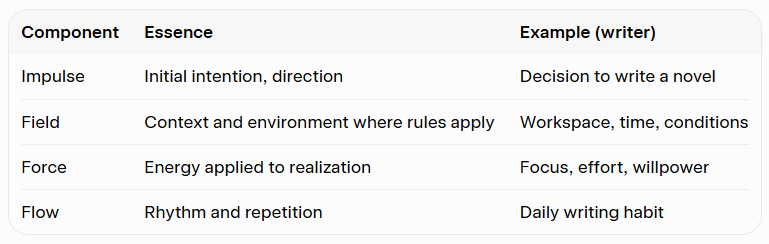
Without any one of these four, crystallization remains incomplete:
- No Impulse → no direction
- No Field → nowhere to act
- No Force → no realization
- No Flow → the structure collapses under the first resistance
3.4. The Corridor of Admissibility
Crystallization does not happen in absolute freedom. It occurs inside the Corridor of Admissibility — boundaries set by higher-order systems (ultimately by the Creator).
These limits include:
- Physical laws (gravity cannot be overridden by willpower)
- Biological and cognitive constraints
- Systemic and ethical boundaries
If Consciousness tries to crystallize beyond this corridor, one of two things happens:
- The required energy becomes unattainable, or
- The resulting structure becomes unstable and self-destructive.
These boundaries are not restrictions — they are the rules of the game.
3.5. Information Gain: The True Output
Why does this complex and energy-intensive process exist at all?
In the material world, energy is conserved. But in the MIR model, something unique emerges: information.
- Distillation of meaning: Crystallization transforms raw Chaos into structured understanding.
- An indestructible resource: Information does not diminish when shared. It remains even when its physical form disappears.
Ultimately, what we accumulate is not matter — but experience transformed into meaning.
Engineering conclusion: Crystallization is the local reduction of entropy. We take chaotic energy and turn it into structured information. The fatigue you feel is the price of this transformation — the cost of enriching the universe with new meaning.
4. Recursion of Consciousness: Student at One Level, Material for the Next
In the MIR model, reality is not arranged as a flat hierarchy with fixed positions of “above” and “below.” Instead, it is an infinite nesting of systems within systems. Any structure we create becomes part of something larger. This property is known as recursion.
From this follows a conclusion that is deeply counterintuitive to the ego: Consciousness simultaneously plays two roles. It is both an architect and material — creator and created.
4.1. Looking Downward: Consciousness as Architect
At the level we typically perceive, we are creators.
- We establish Fields, initiate Impulses, and apply Force to bring Order out of Chaos.
- For the systems we create — whether code, narratives, organizations, or relationships — we function as an external intelligence, a kind of Supermind.
- We define their Corridor of Admissibility — the rules within which they evolve.
- Our task at this level is to distill meaning and sustain Harmony within what we have built.
Example: A writer creates a character. Within the fictional world, the writer is the Creator: defining the character’s limits, personality, and fate. The character exists within the Field established by the writer.
At this level, Consciousness acts like a Mentor or Creator: guiding, shaping, and structuring — but not micromanaging every detail, allowing room for internal dynamics within the system.
4.2. Looking Upward: Consciousness as Material
This is the more difficult perspective to accept.
Everything we have crystallized — our life, beliefs, achievements, identity — is, from a higher level, raw material.
- We ourselves are elements within a larger construction.
- Our efforts, struggles, insights, and transformations are processes occurring inside a higher-order system.
- A higher Consciousness relates to us in the same way we relate to Chaos.
Example (continued): The writer is employed by a publishing house. For the publisher, the writer is not a Creator, but a resource — an author working within constraints. The publisher, in turn, exists within the market, which exists within the broader economy, and so on.
At each level, what was Order becomes Chaos — material for further structuring.
Important clarification: Being “material” is not demeaning, nor does it eliminate freedom. It simply means that freedom operates within a broader framework — just as the systems we create operate within ours.
4.3. Ascension Through Complexity
Recursion is not a trap — it is a ladder.
Transition to a higher level occurs when Consciousness perfects its Flows — when what it has created becomes stable and self-sustaining.
When Order reaches a state where it no longer requires constant input of Force, energy is freed. This freed energy allows Consciousness to expand its perspective. It no longer sees itself solely as the manager of a small system, but as a participant in a larger one.
Ascension does not eliminate will. It refines it — aligning personal Impulses with higher-order Harmony.
The test of Consciousness: Progression requires the willingness to consciously become part of something greater — not through coercion, but through recognition that this is growth.
Refusal (driven by attachment or pride) leads to stagnation and eventual forced reset. Acceptance leads to expanded freedom and a wider Corridor of Admissibility.
4.4. Engineering Metaphor: Programmer and AI Agent
Imagine a programmer creating an AI agent.
- For the agent, the programmer is the Creator — the highest authority it can perceive.
- But the programmer is also an employee within a larger organization. For that organization, the programmer is a resource — part of a broader system.
- If the agent functions reliably, the programmer can move on to designing more complex systems. This is upward movement.
- If the programmer becomes fixated on being “a god” to the agent and ignores their own place within the larger structure, growth stops.
Conclusion of the Section
Recursion does not negate freedom — it structures it.
Every level is both:
- a school, where you learn, and
- a workshop, where you create.
Growth lies in the ability to perceive both directions — and to willingly participate in something larger without losing coherence of self.
5. Entropy and Recycling: The Sanitation of the System
Every form of Order is temporary. In a dynamic universe, no structure remains indefinitely. Eventually, any form ceases to serve development and becomes an obstacle. At that point, mechanisms of entropy (natural decay) and recycling (intentional dissolution) come into play.
This is not failure — it is maintenance.
5.1. The Shelf Life of Order
Any closed system tends toward disorder. In this model, Order begins to degrade when Flow disappears.
Without regular reinforcement:
- ideas become dogma,
- relationships become empty formality,
- skills deteriorate.
What remains is a rigid, inefficient structure — a “monument” that consumes energy but produces no new meaning.
Healthy Order is adaptive, open, and evolving. Unhealthy Order is rigid, defensive, and stagnant.
5.2. Managed Chaos as Mercy
When Order obstructs development, the system initiates its dissolution.
This is not punishment — it is mercy.
- Connections dissolve: Order returns to Chaos.
- Space is freed: new structures can emerge.
- Signals appear: fatigue, boredom, conflict — early warnings before collapse.
Key insight: Only form is destroyed. The information gained remains. Destruction is transformation — not loss.
5.3. Systemic Drift (“Skidding”)
Drift occurs when Consciousness clings to outdated Order and resists necessary change.
Signs of drift:
- increasing effort with decreasing results,
- recurring crises,
- persistent tension.
Signals escalate:
- subtle discomfort,
- repeated obstacles,
- crisis,
- collapse.
If ignored, the system enforces a reset — returning Consciousness to Chaos.
Paradox: What feels like survival is often resistance to growth. Letting go is not defeat — it is transition.
5.4. Healthy vs. Pathological Destruction
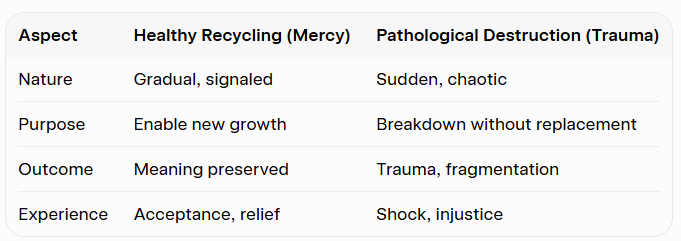
In a well-functioning system (close to the Educator’s intent), healthy recycling predominates. Pathological destruction arises from strong resistance or collective errors.
5.5. Practical Implications
- Learn to recognize when a structure has expired.
- Let go before forced collapse.
- Extract the meaning from every experience.
- Do not identify yourself with temporary forms.
Engineering conclusion: Destruction is recycling. Nothing essential is lost — only transformed. Gather the informational residue and prepare for the next cycle.
6. The Thermodynamics of Creation: Energy Cost and Reboot Mode
Creativity is often idealized as effortless inspiration. In reality, it is energy-intensive work. Every act of ordering requires expenditure — and causes wear.
6.1. The Physics of Observer Wear
Each act of crystallization rewrites Consciousness.
- Energy cost: Force is drawn from internal reserves.
- Friction: resistance generates strain.
- Fatigue: a signal of transformation, not weakness.
Distinction:
- Routine fatigue → no change
- Creative fatigue → growth + transformation
6.2. Consciousness as an “Antenna”
Consciousness operates on two energy circuits:

Flow state occurs when alignment reduces resistance. Even then, wear accumulates — no system is infinite.
When alignment is lost, the system falls back on the lower circuit, leading to rapid exhaustion.
6.3. Sleep and Integration
Rest is not optional — it is systemic maintenance.
- Integration: experiences are consolidated
- Cooling: tension is released
- Realignment: course correction occurs
Without rest:
- meaning is not integrated,
- efficiency drops,
- drift increases.
6.4. Practical Energy Management
- Treat fatigue as feedback
- Differentiate types of exhaustion
- Use transition rituals
- Balance action with recovery
Engineering conclusion: Creativity is high-load processing. Rest is required to sustain function and prevent breakdown.
7. Conclusion: The Meaning of Accumulated Experience
We began this journey with a question: how does Order emerge from Chaos? We have traced the processes of crystallization, recursion, entropy, and the energetic cost of creation. Now we arrive at the central question: what is the final product of this vast machine called the WORLD?
7.1. Information as an “Indestructible Residue”
In the physical world, nothing is eternal: stars burn out, civilizations collapse, bodies wear down. Yet in the MIR model there exists a substance that does not succumb to entropy — information.
- What it is: Every act of crystallization — through Impulse, Field, Force, and Flow — produces a unit of Meaning. This is not material, but structural knowledge: an imprint of what became possible and how it was realized.
- Why it persists: Even when the form that carried it disappears, the fact of its existence remains embedded in the system. Meaning becomes part of the Universe’s “memory” — a permanent addition to its structure.
- Connection to the model: This accumulated informational gain is what the Curator (the ideal future self) uses to refine future cycles, and what the Educator incorporates when shaping new developmental paths.
We do not merely live — we contribute to the evolving architecture of meaning itself.
7.2. Consciousness as a Distiller of Meaning
Within this recursive system, our role is not to construct permanent monuments, but to become increasingly effective distillers.
We take the raw energy of Chaos and pass it through intention, structure, effort, and repetition — transforming it into refined Meaning.
Every decision, every act of organizing reality, is a process of distillation.
The goal is not scale, but quality and alignment:
- how precisely we resonate with Harmony,
- how efficiently we transform energy into meaning,
- how little friction and distortion we introduce.
Whether the act is large or small — a technological breakthrough, a line of code, a conversation, or the decision to let go — it is equally an act of distillation. The system does not measure size. It evaluates coherence, clarity, and resonance.
7.3. Final Conclusion: We Are What We Have Understood
In the end, the only thing we take with us when moving to the next level of recursion — whether a new phase of development or a broader existential shift — is not our possessions, roles, or external achievements. We carry only our transformed structure.
That “terrible fatigue” you felt was the price of change. Each effort to impose Order has reshaped you — made you more complex, more precise, more capable.
You are no longer who you were before crystallization. And that is the point.
We are not merely workers within reality — we are reality reflecting upon itself through our perception, action, and creativity.
The Final Criterion
At the end of any cycle — whether a day, a project, or a lifetime — the essential question is not: “What have I achieved?”
but: “What have I become? How has my capacity to create meaning evolved? Has my alignment with Harmony deepened?”
Your life is not a search for static peace — because static peace is indistinguishable from stagnation.
Your life is a continuous process: Crystallization → Dissolution → New Crystallization. Inhale → Exhale → Inhale.
7.4. Call to Action: The Model as a Living Map
This model is not doctrine. It is a tool — meant to be applied, tested, and refined.
- When you feel exhausted → recognize the cost of transformation and allow recovery.
- When you feel stuck → examine whether you are clinging to obsolete Order.
- When you create → consciously engage Impulse, Field, Force, and Flow.
- When you suffer → ask whether this is correction, learning, or resistance.
Test it. Apply the model to your own experience. Where it fails, refine it. It evolves through interaction.
Share it. Information does not diminish when transmitted — it multiplies. By sharing, you increase its value.
The “Great Transition” described in the first part of MIR begins with each conscious choice. Every such choice crystallizes a fragment of meaning. Each fragment subtly restructures the surrounding Chaos — making it more ordered, more coherent, more aligned with Harmony.
You are not alone in this process. The system — Creator, Educator, Curator — operates with you, not against you.
Fatigue will pass. Forms will dissolve. Meaning will remain.
Final Engineering Note
The system is functioning as intended:
- Chaos provides the resource.
- Order provides structure.
- Consciousness generates Meaning.
- Harmony guides direction.
And your fatigue confirms it: You are participating in the process.
Continue the crystallization.
This article is a free gift. If it helped you, share it with someone who needs meaning. No payment, no subscription — just pass it on. Philosophy, Systems Thinking, Meaning, Creativity, Consciousness, Thermodynamics, MIR