MIR corpus
Attention as a Dimension: How We Rewire Reality
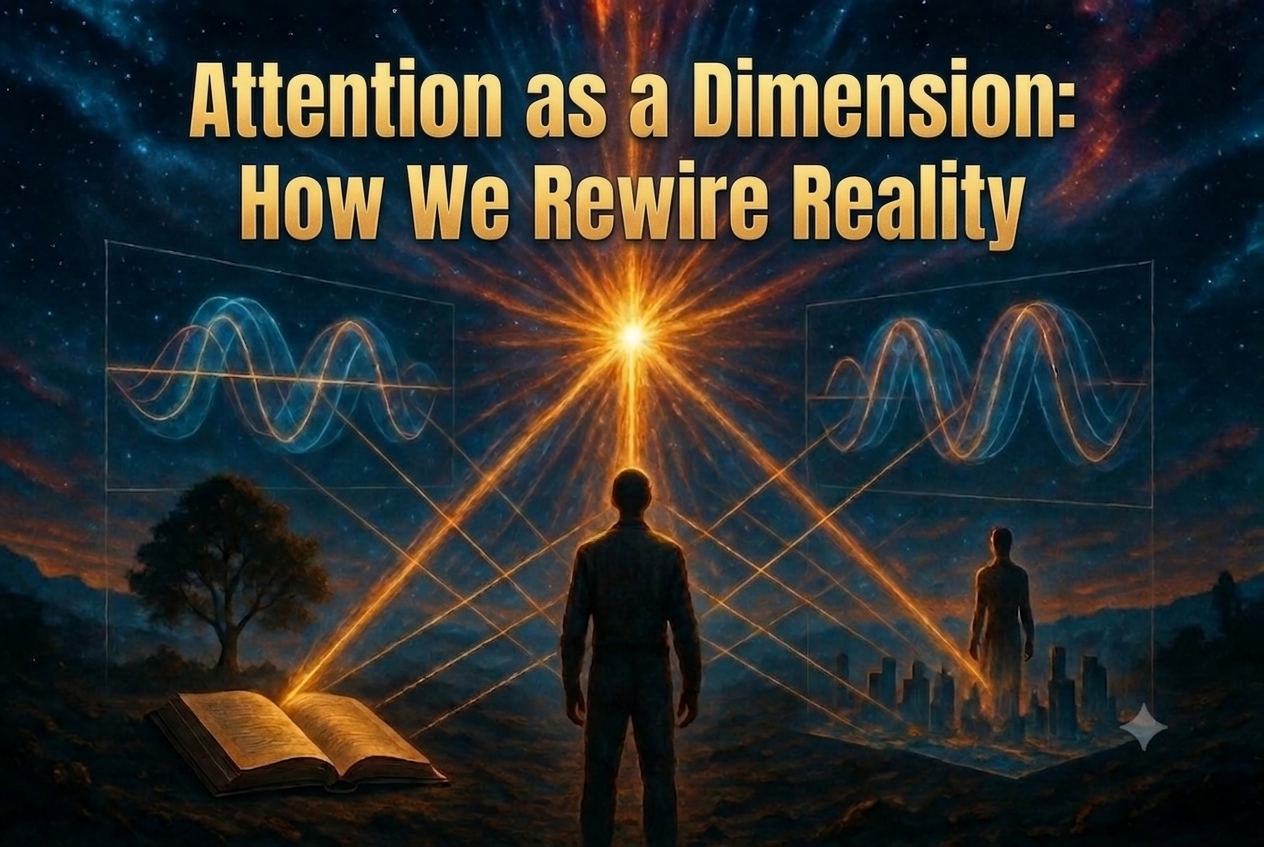
Attention is not a passive screen. It is a two-way piston that irreversibly changes both you and whatever you look at.
Attention is not a passive screen. It is a two-way piston that irreversibly changes both you and whatever you look at.
In earlier articles of this cycle we unpacked how quantum metaphors help us understand the nature of stability (Hero Mode), how ethics works as a flow, and why the balance of tension and release is a condition of life rather than a luxury. Now we come to the main cable running between the Observer and the physical world.
Popular culture has trained us to think of the observer effect as something half-mystical: a person looks at an electron and it stops being a wave and becomes a particle. Tonnes of esoteric speculation have been piled on top of this phenomenon — about the power of thought and about passive contemplation supposedly bending the laws of physics. It is time to clear the fog.
The core claim: attention is not a passive screen and not a peek through a keyhole. It is a two-way physical piston that irreversibly changes both you and the thing you are looking at. Every act of attention is an act of measurement, leaving a trace in both participants of the interaction. And the quality of that trace determines which reality we end up materialising.
Measurement is always mutual deformation
To understand how attention rewires reality, we need to fix one severe fact once and for all: in quantum mechanics, measurement is not passive peeking but any physical interaction that leaves an irreversible trace.
In the macro world it seems you can simply look at a thermometer and learn the temperature without affecting the air at all. At the subatomic level that trick no longer works. To register the position of an electron you are obliged to hit it with something — a photon or another electron. That hit knocks the measured object off its original trajectory. You cannot pull information out of the quantum world without leaving a physical scar on it.
Until the moment of collision, any isolated particle exists in a state of superposition. This is not we do not know where it is. This is an objective reality in which the particle is smeared across space as a wave of probabilities and exists in all possible coordinates at once. The transition of that wave into a single classical point is called decoherence.
And contrary to the central myth, this process does not require a living human being with consciousness. As the physicist Wojciech Zurek demonstrated, the measurer for a quantum object can be any macroscopic environment — an air molecule, the wall of a detector, the cosmic microwave background. The moment a particle collides with a chaotic medium, a physical joining occurs. The wave functions combine into an entangled system. Thermal noise from the environment knocks the phase of the quantum wave off, and the superposition of alternatives falls apart. For the outside world the quantum fog disperses and the system yields one classical outcome.
Measurement is always an act of mutual deformation. The systems exchange impulses, and from that moment neither the object nor the measuring device will ever return to its previous state. They become part of a shared history.
The brain as converter: what attention actually is
When we carry this principle over to human perception, the mysticism disappears and gives way to a strict biological architecture.
The Russian word for attention — vnimanie — carries the sense of taking something into yourself, and that is exactly what happens. It is an act of forcibly absorbing a fragment of the external environment inside the boundaries of your own personality.
In the physical world we are surrounded by a chaos of heterogeneous carriers: light waves (photons), vibrations of air, pressure on the skin, chemical molecules. All of these are different types of material signal. But for our consciousness that division does not exist. Why? Because a hardware interface is deployed inside the body. Sense organs and receptors work as biological sensors, converting any type of external impact into one universal format — the electrical nerve impulse. And the brain is the master converter, gathering millions of such impulses per second and processing them into a single fabric of Information.
The physical chaos of the environment → bio-receptors → the brain-converter → pure information.
A directed focus of attention is the launching of that converter. You are not merely looking — you are capturing, filtering and integrating the data of reality into your own structure.
To separate conscious attention from a blind physical process, consider a hard marker — a book lying in the sunlight. From the standpoint of classical physics the interaction is running at full power: the book is bombarded by billions of photons, it heats up, its molecules move. And yet the book stays silent. Its colossal potential of meaning remains locked, because the sun is a mindless, entropic source of energy. It does not look for structure; it destroys structure.
The informational layer of the book breaks through only when an Observer enters the circuit. Your gaze is charged with a conscious purpose. You are not warming the pages — you are using the brain-converter to decode symbols into meanings. At that moment the interaction stops being idle noise. You close a fundamental circuit: a material carrier activates an informational code, which rebuilds your own structure.
Information cannot be removed — only added
Everyday thinking carries a dangerous illusion: that information can be taken out of an object like an apple out of a basket, leaving the object untouched. You read a book, the knowledge appears in you, and the book stays exactly as it was. It sounds logical. At the fundamental level it is false.
Information theory, allied with quantum physics, claims the opposite: information in the universe cannot be extracted. It can only be added.
When you read a book the text on the pages does not vanish. The letters do not fade. But this book is no longer the one that existed before you read it. Why? Because in the moment your brain-converter tuned itself to the object, a quantum coupling formed between the atoms of your body and the molecules of the paper, mediated by reflected photons. You became a single system. And new information was written into that system permanently.
In quantum physics this is called back-action: it is impossible to extract information from a system without leaving a physical trace on it. The universe works like a colossal blockchain — it has no erase function and no roll back. It can only append new blocks of data to the shared history.
What exactly gets written? At the point in space where the object was located, MIR forcibly records a new transaction: this fragment of reality was brought out of its latent state and read by a specific Observer at a specific moment in time. The object is enriched. Its quantum memory registers the fact of your presence. And from now on any further trajectory it takes through reality will be calculated by the system with that new record taken into account. You left an invisible but irreversible imprint on it.
Every act of attention is not harmless observation. It is a transaction that rewrites the history of the object. Everything we pay attention to permanently changes its status in the general architecture of reality. We do not study the world — we continuously rewrite it.
Which raises the main question: what exactly are we writing into it, besides the dry fact that an Observer was here?
Motive as the coefficient of efficiency
If the universe keeps an irreversible log of all interactions, then what lands in that log is not a faceless identifier. Into the quantum memory of the object goes the full spectrum of the Observer’s characteristics at the moment of measurement. And the key one among them is the Motive.
Motive is not an abstract mood. It is the concrete geometry and direction of the energy flow — Delta E — that your Personality generates. Depending on the vector of that flow, MIR switches on fundamentally different regimes of conductivity.
The vector toward yourself — fear of scarcity, egocentrism, the wish to hold on, to appropriate, to compensate for an inner emptiness. In this regime your focus works as an informational black hole. The vector points inward, toward narrowing. The object reads that deficit, that subtraction. A marker of tension is written into its system. Conductivity drops, the medium begins to offer a viscous resistance. You run into the hard limit of your current capacity.
The vector away from yourself — creation, gratitude, investing structure and care into the outer world. In this regime your focus becomes a radiator. You make an extraordinary effort not in order to take, but in order to lower the chaos around you. Metadata of the highest order is stitched into the object — a code of development. The system recognises you as an efficient node. Conductivity becomes nearly absolute: obstacles part, reality assembles easily and without pain.
Motive is the coefficient of efficiency in our basic engineering chain:
Problem → Question → Extraordinary effort (Delta E) × Motive → Conductivity → Decision → Handover
If the sign of the motive is positive — away from yourself — your extraordinary effort is multiplied by the support of the whole system. If it is negative — toward yourself — part of the energy goes into friction, into useless heat, into noise.
Ethics in this model stops being a moral choice. It becomes strict engineering: the quality of your motive directly determines the quality of the reality you crystallise.
Fear and resistance inside the Observer
If motive sets the vector, then inside the observer there is constant interference.
Fear is chaotic decoherence. It arises when you prematurely measure a negative outcome: you run the failure scenario in your head, live it through the body, let your attention fix on the worst variant. Fear knocks out your inner coherence, blurs the focus and forcibly collapses the superposition before you have even begun to act. It works exactly like the thermal noise of the environment we described in the first chapter: it destroys the coherence of the system.
Resistance is not fear. It is a coherent signal. It appears when you are already prepared to act but your inner compass points out: this path is not optimal, something here is off. Resistance does not paralyse — it refines. It does not narrow attention; on the contrary, it switches on a closer mode of examination.
Fear says: I am afraid I will not cope, that it will hurt, that I will lose control. It pulls you backwards, into the safe and the already known. It narrows the field of possibilities and makes you act from scarcity.
Resistance says: I can do this, but there is something here I have not taken into account. I need to look deeper. It does not cancel the action; it demands that the action be made more precise. It widens the field of view.
In Hero Mode we said that a hero is not someone who feels no fear, but someone who knows how to stop fear from completing the measurement before the action begins. Now we can say it more precisely: a hero knows how to tell fear from resistance.
Fear should not be suppressed — it should not be fixed upon. Notice it, acknowledge it, let it go, and do not allow it to become the only measured variant. Resistance should be heard. It often points to a blind spot, to an unaccounted factor, to the fact that your motive is not yet clean enough or your plan not yet precise enough.
In practice it looks like this. When a wave of tension rises inside, ask yourself: Is this fear trying to stop me? Or is this resistance trying to refine me? The answer usually comes instantly — if you are honest with yourself.
Fear is noise to be damped. Resistance is a signal to be amplified. Telling them apart is one of the key skills of managing attention, and therefore of managing reality.
The capacity of the subject
From the mechanics of directed flows one more fundamental notion follows — the capacity of the subject. This is a basic parameter of a personality, defining how large a volume of resources — energy, money, influence, information, material goods — a person is able to hold stably inside their zone of attention without self-destruction.
Capacity is not a container in the static sense. It is the throughput of a flow-through accumulator. It is measured not by how much enters you, but by how much you are able to pass through yourself and give away without losing your integrity.
Most people make a fatal mistake by perceiving themselves as a closed vessel. They believe capacity grows at the moment of receiving, accumulating, appropriating. But the thermodynamics of living systems works differently: the capacity of a subject is a dynamic quantity, and it scales exclusively at the moment of conscious handover.
Overload and forced heat losses. When a person with the motive toward myself tries to pump in more resources than their current capacity can bear, pressure rises sharply inside a closed system. No useful work is performed, the energy finds no outlet. The excess is obliged to dissipate — to turn into heat. In life this shows up as forced discharge:
Financial leaks: sudden fines, expensive things breaking, forced spending out of nowhere. Conflicts and ruptures: tension with nowhere to go breaks out in quarrels, grievances, destroyed relationships. Illness and chronic fatigue: the body cannot carry the overload and starts switching off the excess through symptoms. Project catastrophes: a business that grew without any grasp of its founder’s throughput suddenly collapses for no visible reason.
The person sincerely does not understand why everything is falling apart in their hands. The reason is simple: they are overfilled with what they are unable to pass further on. MIR forcibly discharges the excess, but does it inefficiently — through noise rather than through creation.
Handover as expansion. When a person acts with the vector away from themselves and consciously gives a resource, a piece of knowledge, care or structure into MIR, they perform quantum work. The giving creates a momentary potential vacuum inside them — free volume. But because the impulse was directed at lowering chaos, the macrosystem compensates that volume with a surplus in the next cycle.
Every creative transaction is like a powerful current passing through a flexible cable: it microscopically widens and enlarges the walls of your capacity. To carry megawatts, the circuit is obliged to become thicker. By giving one unit away, you rebuild yourself so that in the next cycle you are able to hold and to conduct ten.
This is exactly why people who live by the principle of giving more than they received turn out, over time, to be more capacious, more stable and freer than those who only accumulate. They are not merely richer in spirit — they are literally scaling their conductive capability inside the informational structure of reality.
Capacity does not grow in the moment of endless tension, and not in the moment of pure rest. It grows at the seam: tension — handover, extraordinary effort — gives way to release — integration, recovery — and every such cycle widens the walls of your flow-through accumulator.
Synchronised attention: how mass events are materialised
When we scale the law of mutual rewriting from one person to millions, we get a working formula for the governance of global historical processes.
The future, before it arrives, is a multi-variant superposition. By directing our individual attention there with a particular motive, we make a micro-choice, crystallising a specific probability. It works like the quantum Zeno effect at the scale of a life: whatever we fixate on continuously and with a definite motive is literally frozen into reality, preventing alternative branches from developing.
But the capabilities of a single observer are limited by their individual Delta E. When a large-scale event has to be materialised by force, technologies for synchronising the attention of the masses are switched on.
This is exactly where the true physical meaning of the call Glory to is laid bare. State and ideological slogans — Glory to labour, Glory to the Party, Glory to the heroes — are not empty ritual phrases. In the language of quantum information theory they are a directive command to forcibly turn the attention vectors of enormous masses of people.
Mass media and the agenda → the command Glory to → synchronisation of millions of observers → avalanche pumping of a single point → burning out of alternative branches → hard materialisation of the required outcome.
Mass media act as a gigantic particle accelerator of human attention. When millions of brain-converters aim their measuring circuits at one point at the same time — at the image of an enemy, a victory, a crisis or a national leader — the density of collective measurement becomes monstrous. All the alternative branches of reality are simply burned out, deprived of any energy supply. The variant buried under a colossal volume of mass attention is forcibly brought out of superposition and hammered into physical reality.
The quality of this collectively created future is rigidly determined by the motive. If the agenda gathers attention through fear, hatred and scarcity — the motive toward oneself — the materialised reality turns out to be overloaded with heat losses. It generates internal friction, conflict, and eventually destroys itself. If the circuit can be assembled on a clean creative motive — away from oneself, service to a shared meaning, strengthening of integrity — then metadata of the highest order is stitched into the crystallised event. Such a reality holds through inner harmony and does not require energy to be discharged through catastrophe.
The other side of synchronisation: why society persecutes the “mad”
From this mechanics follows a crucial social law, which explains why in every era people with a non-standard worldview have been isolated, treated or destroyed — regardless of whether they were aggressive.
Collective reality holds together through the coherence of the attention of millions. If inside that field a node appears whose attention is directed at a radically different image of the future, who is charged with high internal energy (Delta E) and who is resistant to external reformatting — not susceptible to collective synchronisation — then that node becomes a local source of decoherence.
His attention is an independent measurement, one that begins to crystallise an alternative branch of reality. If the node is powerful enough, it creates an interference pattern — a blurring of the shared reality, the appearance of doubts and alternative interpretations in other people.
The system therefore has two ways of dealing with him. Cut off his attention’s ability to influence others. Or reformat his reality by force — through ideology, propaganda, violence, psychotropic means — by compelling his attention toward the collective picture.
The cheapest method is to declare him mad. Once that label is attached, his attention loses legitimacy as an instrument of measurement.
Society does not particularly care whether such a person is aggressive. The point is not the behaviour but the direction of attention. Even if he is quiet, if his inner world is radically different he already represents a threat to the coherence of collective reality. This is why it was never only rebels who were persecuted, but also hermits, mystics and geniuses with a non-standard worldview.
The other side of this law: it is precisely such “madmen” who eventually become the makers of new eras, when their alternative measurement turns out to be more stable and more viable than the old collective reality. But for that, their attention has to be powerful and clean enough to outweigh the collective synchronisation.
This mechanism works not only at the level of states but also in small groups — in teams, families, communities. Collective attention synchronised around a shared goal with a clean motive creates a stable reality. And any deviation from that synchronisation is perceived as a threat — and suppressed.
Attention as engineering
We have walked the whole path through. We began with a microscopic photon that irreversibly changes the spins of electrons on a page under your gaze. Then we rose to the architecture of the brain — the universal converter turning the chaos of physical signals into pure information.
We unpacked a fundamental law of the universe: information cannot be removed, only added. We understood that with every act of attention we do not merely look at the world but rewrite its history. We introduced motive as the coefficient of efficiency, determining whether our extraordinary effort dissipates into friction or is multiplied by the support of the whole system. We took apart the dynamic capacity of the subject and saw that it grows not from receiving but from giving. And finally we scaled the law up to the macro level, showing how global events are materialised through the synchronisation of millions of observers — and how the system suppresses those nodes of attention that begin to crystallise an alternative reality.
Along this path no room was left for mysticism. The MIR model unites physics and ethics into a single strict engineering discipline. Your Personality is not a passive passenger. Your brain is a converter of fields into information. Your attention is the main measuring and rewiring instrument of reality.
Understanding this process strips ethics of its moralising varnish. Hero Mode is the ability to stop fear from performing a premature measurement. Ethics is the practice of managing motive as a coefficient of efficiency. Tension and Release is the working regime in which capacity expands through cycles of giving and recovery.
None of this is abstract advice. It is engineering. Directing the flow away from yourself and consciously managing your attention is not a spiritual feat. It is the only mathematically grounded way to expand your own dynamic capacity, to overcome the chaos of the environment and to become a genuine co-author of the architecture of the MIR around you.
The cleanliness of the motive is not a moral choice but a condition for the stability of the reality you crystallise. The cleaner the channel, the more precise the result. This is exactly where physics, ontology and ethics converge at a single point: the management of attention becomes the highest form of engineering optimisation available to a human being.