MIR corpus
The Engineering of Spirit
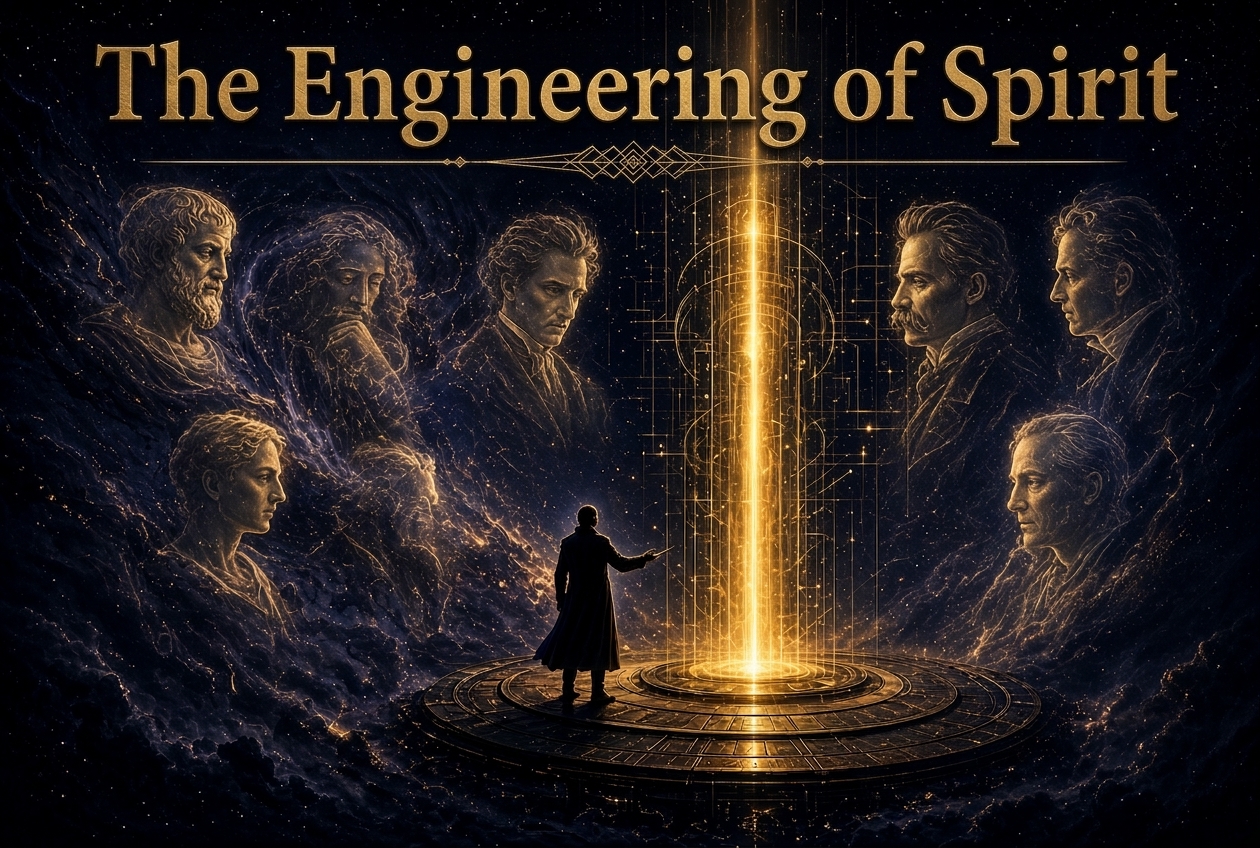
Not a set of rules to obey, but an assembly drawing: how to calibrate yourself so your force becomes a reactor rather than a bomb.
Not a set of rules to obey, but an assembly drawing: how to calibrate yourself so your force becomes a reactor rather than a bomb.
This text has no ambition to retell you what you can find in a library. It does not aim to make you a good person in the sense usually packed into those words. Its task is to gather into one place what has been lived, tested to breaking point and calibrated in real conditions.
There is a rule worth writing out in large letters before we begin. Let it hang over everything that follows.
The small thing you reached by yourself matters far more than the greater thing someone else told you about.
This is not a dismissal of great minds. It is a correct ordering of priorities. A truth won through your own experience — through mistakes, doubts and inner wars — is built into you at the level of hardware. It stops being a quotation you have to recall and becomes part of your optics, the thing you look through without noticing it.
A truth received from outside, however lofty, often stays mere information. Beautiful, convincing, and lying on the surface. It has not passed through your life, and so it has not become yours. You can quote it, but you cannot lean on it at the critical moment.
So we are not going to study ethics. We are going to assemble it. Assemble it out of what you already know but have perhaps never formulated. Out of those intuitive flashes that visit every thinking person and rarely get a precise shape. Out of the mistakes you have made, which — taken apart properly — become the best teachers.
This text is not a lecture. It is an assembly drawing.
There will be no names and quotations here for their own sake. But there will be interlocutors. Those who walked this road before us — Aristotle, the Stoics, Kierkegaard, Spinoza, Nietzsche, Weil, Frankl, Levinas. We turn to them not to say look how well-read I am, but for verification. For argument. For refinement. As equals, from whom something can be taken and with whom something can be flatly disagreed. They are mirrors in which our architecture is reflected and tested for strength.
The final aim of everything said here is not contemplation and not escape from the world. This is not the ethics of a hermit. It is the ethics of a doer. The aim is to calibrate your inner control centre so that you can act with maximum force and minimum destruction — so that your strength, your will and your reason do not build an unpleasant world of oppression and exploitation around you, but take part in the development of the large System you are a part of.
This is the path from a chaotic impulse to a conscious, precise, calibrated action. The path of an engineer of spirit.
If that resonates — welcome. We begin the assembly.
Reality as breathing
Before speaking about ethics we need to agree on what kind of world we live in. Because the answer to how should I act? depends directly on the answer to how is reality built?
If the world is a frozen stage set, made so that we could play our parts on it, then ethics inevitably reduces to a code of conduct for actors. If the world is chaos devoid of any logic, ethics loses its meaning and gives way to arbitrariness. Our axioms are different.
Look at reality not as a thing but as breathing. This breathing has two phases.
The first is the inhale. The moment when chaos gathers into structure. Out of disordered, seething uncertainty, order crystallises. A form is born, a rule, a system.
The second phase is the exhale. The moment when any form, however perfect, having served its term, dissolves back into chaos. It is no longer needed; it becomes a resource for the next cycle, for a new inhale.
Everything we see around us — from galaxies to social institutions, from scientific paradigms to our own convictions — is a temporary crystallisation. Every order has a shelf life.
This is a fundamental divergence from what the Stoics thought. Their Logos is a rational, pre-established and, most importantly, eternal order. The task of a human being is to recognise that eternal pattern and fit into it, to consent to it. Their ethics is an ethics of harmonising with an already existing, unshakeable architecture.
But if reality is not a frozen Logos but a process of breathing, our task is fundamentally different. Not to find a place assigned forever, but to learn to take part in that breathing — to create forms in time and to release them in time, without clinging to what has served its term. Holding on to what ought to dissolve means obstructing the process.
Who am I inside this process
If the world is a process, who am I in it?
The habitual picture draws the I as a separate observer. There is an enormous world, and there is me, looking at it from the side and deciding how to relate to it. This is an optical illusion — convenient, but inaccurate.
More precisely: I am a local process inside a single System. I do not stand opposite reality; I am one of the ways reality manifests itself.
Spinoza put this in his almost mathematical language. There is one single substance — he called it God or Nature, Deus sive Natura. And everything we take for separate beings — people, animals, stones, thoughts — are modes, temporary manifestations of that one substance. There is no separate you and no separate world. You are an aspect of the whole, a point at which the System becomes aware of itself and experiences itself.
For ethics this is decisive. If I am a separate observer looking at the world from outside, ethics inevitably becomes a matter of bargaining: how do I interact with others so that things go as well as possible for me? That is the ethics of the contract.
But if I am a local process of the System, the border between mine and not-mine dissolves. My action is always the action of the whole System at this point. And the question stops being what is more profitable for me? and becomes which of the things I can do at this point will serve the development of the whole System?
This is the shift from egocentric ethics to systemic ethics. To what we will later call thinking from Level 4.
The Corridor of Admissibility
So the world is a process and I am part of it. That sounds almost like fatalism. If I am merely a local process, where is my freedom?
Freedom does not lie in abolishing your conditioning. Freedom lies in knowing exactly the borders inside which you really can choose.
You cannot always choose the conditions you are in, but you always choose how to act within them.
This is the Corridor of Admissibility.
The conditions we find ourselves in are given. They are set by our body, by the time and place of birth, by past choices, by external circumstances, by the actions of other people. All of it is input we do not control at the moment of acting. We cannot instantly change our past, move to another point in space or grant ourselves different abilities.
This is not pessimism. It is a sober engineering statement. Like any system, we have inputs that do not depend on us. The Stoics called this things not in our power and spent great effort learning to tell them apart. Viktor Frankl, who went through the extreme experience of a concentration camp, confirmed it with his life: even under conditions of almost total unfreedom, a person retains the last freedom — the freedom to choose their attitude to what is happening.
But acknowledging the borders is not capitulation. On the contrary, it is stepping out of an illusion. While we try to control the uncontrollable, we waste energy and, worse, miss what really is in our power.
And what remains in our power is always the space of choice inside that corridor. How exactly will I act under these already given conditions? With what intonation will I answer an insult? How will I react to failure? Where will I direct my attention in the next moment?
It is here, in this space, that character is born. It is here that we become who we become. This is the starting point. All real ethics begins here — not with fantasies of omnipotence, but with precise knowledge of your borders and your genuine responsibility.
Freedom is not “I do what I want”
When people are asked what freedom is, the most common answer is: freedom is doing what I want. The definition is so widespread that it looks self-evident. Let us look more closely.
Doing what I want is a formula that puts desire at the centre. And desire is a tricky thing. Very often it is not ours. It can be imposed by advertising, upbringing, fear of loneliness, social pressure, an affect, a hormonal surge. A person who does everything they want often turns out not to be free but managed. They simply cannot see who is pulling the strings.
Freedom is not I do what I want, but I do not do what I do not want.
This is a definition through immunity. It is a protective contour. Freedom begins not with expansion but with the ability to say no.
No to manipulation. No to imposed guilt. No to the affect pushing you into stupidity. No to the crowd demanding that you be like everyone else. No to your own fear paralysing your will.
Spinoza called this freedom from the bondage of the affects. While I am moved by obscure causes I do not understand, I am not free, even if it seems to me that I am doing what I want. I can want to destroy myself with alcohol, drugs or toxic relationships. I can want a revenge that will annihilate me first of all. Is that freedom? No. It is slavery, merely comfortably furnished.
Freedom as immunity is the first step toward real adulthood. It is the ability to stop yourself at the edge when everything inside is screaming go on! It is the ability to see manipulation and not fall for it, even when the manipulator is you.
This is not yet the whole of freedom. But without this foundation everything else is built on sand. First we learn not to do what we do not want to do. And only then do we work out what we actually want — from the depth, not from the surface.
Four versions of the operating system
What is personal development? It is usually thought of as accumulation — of knowledge, skills, experience, money, status. In that logic a developed person is one who has a lot of everything.
But this model misses the main thing. Imagine a computer. You can install an enormous number of programs on it, fill the hard drive with terabytes of data. But if the operating system is outdated, all those programs will run slowly, crookedly and in conflict with each other.
Real development is not the accumulation of software but a change of operating system.
Our inner OS is our Centre of Control. It is the point from which we take decisions. And it is defined by a very simple criterion: whose interests do I take into account when I say this is good or this is bad?
This centre is not static. It can shift. And it is in that shift that the genuine evolution of a personality consists. We do not simply become cleverer or more experienced. We change the very optics through which we look at the world and at our actions in it.
OS 1.0 — for myself. The centre of control is compressed to the point of I. The criterion of evaluation is my personal gain. This is neither bad nor good in itself. It is simply the initial, base version everyone is born with. A child lives from this OS, and that is normal. The problems begin when this version remains the only one for a whole life. An adult on OS 1.0 perceives the world exclusively as a resource for their own satisfaction. Other people are either instruments or obstacles. Ethics is not needed here; it is replaced by calculation — what do I get for this, and how do I avoid being caught? Kierkegaard would have called this the aesthetic stage: a person lives by sensations and impressions and avoids everything that demands responsibility.
OS 2.0 — for my own people. The centre of control expands to the borders of ours. Family, clan, circle, company. The criterion is the interests of my group. This is already more complex than pure egoism. The ability to sacrifice the personal for the common appears. But that common is still bounded by the circle of one’s own. What is good for my family may be bad for the neighbours. What is good for my company may be destructive for the market. Ethics works inside the circle and switches off beyond it. This is corporate ethics, clan morality — powerful, but not universal.
OS 3.0 — for one’s neighbour. The centre of control expands to the scale of the social contract. The criterion is the common good, justice, equality before the law. This is the level at which constitutions, human rights and classical morality operate. The neighbour here is not necessarily someone I know and love, but any other person whose interests I am obliged to take into account simply because they are part of the same network as me. This is already a serious achievement. Many ethical systems stop precisely here, considering it the summit.
OS 4.0 — for the development of the whole System. The centre of control shifts beyond not only the personal but the human. The criterion is: what serves the development, the growing complexity and the harmonisation of the System as a whole? The same System we described at the beginning — the one that breathes, crystallises order out of chaos and dissolves it again.
This is not a rejection of the human. The human remains part of the equation. But the equation itself is evolution, development, the movement of the System toward greater complexity.
At this level the question stops sounding like is this profitable for me? or is this fair? It sounds like this: does this serve the development of the whole? Am I obstructing, with my private interest, the large movement that is going through me?
If you raise your motives to the needs of the whole system, you become very valuable to the system.
Value here is not a reward and not praise. It is an engineering fact. An agent able to act from the logic of the whole rather than the logic of a local centre stops being an obstruction, a virus, a distortion. He becomes a conductor. His action acquires a different quality — it stops being reactive, defensive, self-serving. It becomes a clean contribution to the architecture of reality.
Aristotle and the missing variable
Here we must stop and bow to Aristotle.
Aristotle created a great model of ethics. He said: virtue is not an extreme but the golden mean. Courage is the mean between cowardice and recklessness. Generosity is the mean between stinginess and prodigality. This is brilliant.
But there is a nuance. Aristotle did not account for — or, more gently, did not make explicit — one critical variable. The mean is not absolute. It depends on who is looking at it. On their point of sitting. On the version of their Operating System.
Take generosity. What is the golden mean for a person on OS 1.0? To give another exactly as much as will pay off — in reputation, a return favour, loyalty. Give nothing and you are known as a miser. Give too much and you are the fool. The mean is calculated from personal gain.
And what is generosity for a person on OS 4.0? It is the optimal distribution of a resource at that point of the System where it will yield the maximum increase in complexity and harmony. Sometimes that means giving everything with no expectation of return, because that is precisely what the whole needs now. From the standpoint of OS 1.0 this is madness. From the standpoint of OS 4.0 it is a precise, measured act.
True practical wisdom — what Aristotle called phronesis — is not merely the ability to hit the mean. It is the ability to hit the mean corresponding to the highest Centre of Control available to you.
You cannot learn this from books. It comes only with the practice of widening your optics. With the practice of shifting that very point from which you look at the world and say: this is good, this is bad.
The transition between these levels is not smooth. It is not accumulation. It is a leap. What Kierkegaard wrote about: a change in the mode of existence is given not by gradual improvement but by a qualitative jump, often through crisis and despair. The old OS has to stop working so that room is freed for the new one.
Four steps of reflashing
Most ethical systems stumble exactly here. They give a map but no transport. They describe the destination and say nothing about how to get there. That gap needs closing.
What follows is a concrete technology. Not metaphorical but working. Tested not by armchair reflection but by the practice of inner rebuilding. This is the technology of interiorisation — growing a new ethical code into the very fabric of your being. Four steps. In sequence. No skipping.
Step 1. The deed of the hands. Any rebuilding starts from the outside. This is the first and crudest, but absolutely necessary stage.
You are still old inside. Your desires, thoughts and habits still run on the previous version of your OS. But you already know you want to change it. And you begin with the only thing genuinely under your control right now — your external action.
You simply force yourself to do what corresponds to the new version of you. Or not to do what contradicts it. Even if everything inside resists. Even if it feels false and unnatural. Even if you want to drop it all and go back to the familiar.
This is an act of will. Brute force against settled inertia. Aristotle called it the forming of habit. He said: we become just by performing just acts. First you do, and only then you become. Not the other way round. Habit is the bridge between the old self and the new one. You step onto that bridge before you begin to believe in it.
At this stage do not wait for purity of motive. There will be none. There will be hypocrisy, inner protest, thoughts like why am I doing this, it is not sincere. That is normal. You are not doing it in order to be sincere. You are doing it in order to tread a new neural path on the map of your behaviour.
First you stop stealing because you fear punishment. Then you stop lying because it destroys relationships. Then you make yourself help even when you do not feel like it. You are creating a new channel for action. The water is still the old water, but the channel is new.
Step 2. The thought of the head. When the external action has become more or less habitual, the turn of the inner space arrives.
You have stopped doing what you consider wrong. But you still think about it. You still run scenarios in your head: what if I had answered differently back then? Maybe I gave up that advantage for nothing? And that person did not deserve my help, yet I gave it anyway.
This is mental spam. It clogs your working memory and consumes resource. As long as you keep thinking about something, you are still attached to it. A thought is a thin thread holding the old reality ready. If you have stopped stealing but constantly think about how good it would be to steal, you have not moved past the first step.
So the second step is clearing the mind. You learn not to think about what you have stopped doing. Notice the thought — let it go. Do not fight it, do not condemn yourself for it, simply stop feeding it with attention.
The Stoics called this working with impressions: do not let a false judgement capture your mind. Epictetus said it is not events that disturb people but their judgements about events. Remove the judgement and the disturbance disappears.
This is hard. The mind is used to chewing the same gum. But if you disciplinedly return your attention to the present moment, to the work, to reality, the old neural links begin to weaken. You stop being a mental accomplice of what you have already renounced at the level of action.
First you do not do. Then you do not think.
Step 3. The desire of the heart. This is the deepest and hardest stage. Here the real transformation happens.
Until now you have worked with behaviour and thinking. But both are only surface layers. Underneath lies the core — your true wants. What actually motivates you. What brings pleasure. What you reach for when nobody is watching.
At the third step you get down to that core. You have stopped doing the wrong thing and stopped thinking about it. Now your task is to stop wanting it.
This is not about suppression. A suppressed desire is still a desire. It has merely been driven into the basement, from where it will sabotage your life. Real transformation is when a desire changes its nature. What seemed sweet becomes a matter of indifference. What attracted begins to repel. And the reverse: what used to require effort begins to bring joy.
How does that happen? Not through violence but through deep reconsideration. You see the consequences. You understand where a given desire leads. You reconnect the broken link between an action and its distant result. And at some moment there is a click. The desire disappears not because you forbade it, but because you outgrew it. It is no longer yours. It belongs to an older version of you that no longer exists.
This is what Spinoza meant when he said that an affect ceases to be an affect as soon as we form a clear and distinct idea of it. Understanding heals. Not will, not prohibition, but a clear sight of causes and effects.
You no longer want to take what belongs to another — not because it is forbidden, but because it does not interest you. You no longer want to humiliate anyone — not from fear of punishment, but because you see in it a sign of weakness that disgusts you.
Step 4. The steps of the feet. Once the first three steps are done, the fourth arrives almost automatically. But it must be recorded separately, because it is the goal of the whole process.
At this stage the new ethical behaviour stops being an effort. It stops being even a conscious choice. It becomes your second nature — as natural as breathing or walking.
You act rightly not because you are a good person. Not because you remember a commandment. Not because you fear consequences. But simply because you can no longer act otherwise. It has become part of your essence, of your new firmware.
Imagine learning to drive. At first you think about every movement: clutch, gear, mirror, indicator. It is agonising. You act, but your mind is full of thoughts (steps one and two). Then, through practice, you stop thinking about the pedals. You simply want to turn, and your hands make the movement themselves (step three). And a few years later you can drive while listening to music, talking to a passenger and noticing a beautiful sunset. Driving has become part of you (step four).
The same with ethics. When a new system of values has been assimilated to the level of automatism, your selfhood finally stops occupying the throne. Not because you drove it out by force, but because it has become part of a larger architecture. It no longer needs to govern, because governance happens at a higher level.
This is the state we are looking for. A state in which you act powerfully, precisely and without inner friction. In which ethics is not a code of rules hanging over your soul but the natural working regime of your system.
The deed of the hands — the thought of the head — the desire of the heart — the steps of the feet. This is a technology of reflashing. It works. It can be verified. It is available to anyone prepared to walk the steps in order, without skipping and without deceiving themselves.
Attention: the interface
All of this — the architecture and the method — stays a dead scheme without one key element, which is at once the main working instrument and the most vulnerable point of the whole system. That element is Attention.
Attention is the interface. It is what we touch reality through. It is not merely the ability to concentrate. It is an organ of perception that determines what exactly we will see, how we will evaluate it and, ultimately, how we will act.
Active Attention is what we habitually take attention to be. A beam. A scanner. An instrument we direct at the world in order to measure it, evaluate it, understand it and — this is the key point — change it.
Active attention does not passively register facts. It participates in forming them. When I look intently at a person, they react — adjust their clothes, change posture, grow nervous or, on the contrary, blossom. When I focus on a problem, I already influence it by the very act of focusing, cutting it out of the background and endowing it with significance.
This is the regime of creative, forming participation in reality. It is what makes us doers. It is what we build, explore and conquer with. Without this mode no creation is possible.
But it has a shadow. Active attention almost always carries a charge of appropriation. I am looking turns far too easily into I want, I judge, I use. My gaze directed at the world often turns out to be not merely a beam but a hand trying to seize and hold. And the world, sensing this, either resists, or distorts itself in response, or — worse — allows itself to be seized, and then I receive not reality but a trophy, a dead cast.
Here we need the second mode. The one Simone Weil spoke of, which she considered the highest form of prayer. Call it Receptive Attention.
This is the ability to perceive without appropriating. To look without announcing yourself. To listen without preparing an answer. It is not the cold, detached observation of a scientist. It is, rather, an attempt to become so transparent, so quiet, that reality — another person, a natural phenomenon, a complex idea — can manifest in you without distortion, without your weight, without your greedy need to interpret, evaluate and use everything.
This is very difficult. It is almost unnatural for our active nature. We are used to attention being an act. Here what is proposed is an anti-act: not to grab but to wait. Not to form but to receive.
Active attention says: I am studying you. Receptive attention says: I am removing myself so that you can be seen.
Both modes are necessary. One without the other is either blind force or barren passivity. Mature command of the interface is the ability to switch between them, knowing when to act with the beam and when to withdraw the beam and become a receiver.
The virus: Selfhood on the Throne
And now we come to the subtlest and most dangerous place.
All our work — changing the OS, the four steps of reflashing, developing active and receptive attention — has one aim: to shift the egoistic centre of control and stop being a slave to our small wants. But it is exactly here that the most sophisticated virus lies in wait.
That virus is the ability of our selfhood to mimic.
We begin working on ourselves. We notice our shortcomings. We learn to say no to our weaknesses. We practise receptive attention. And after a while we begin to feel... pride. I am becoming better. I am working on myself. I see what others do not. My motives are getting cleaner.
At that very moment the selfhood we were trying to dethrone changes into the robes of spiritual progress and climbs back onto the throne. Only now it governs not through crude desires but through a subtle, almost unbearably pleasant sense of superiority.
You take pride in your purity. You award yourself a mark for every right choice. You look down on those who have not yet grown up. This is the virus Selfhood on the Throne. Its most perverse form is when even the cleansing of ego becomes a project for improving that very ego.
The trap snaps shut when you begin to concentrate too hard on your own sense of choosing, on your progress, on your inner purity. You stop looking at reality and start endlessly examining yourself in the mirror: Am I pure enough? Am I choosing correctly right now? What is my level of motivation at the moment?
This is a bad infinity. It is ethical hypochondria. And it is more dangerous than crude egoism, because it hides behind good intentions.
The vaccine. A simple, hard formula is needed — one that knocks down the arrogance and returns the system to reality.
The world is beautiful without me too.
This is not a depressive assertion of your own worthlessness. It is a hygienic procedure. It is the antidote to a megalomania which, as it turns out, knows how to dress in the robes of sanctity.
When you catch yourself swelling inwardly with pride over your right action, say it. The world existed for billions of years before you. It was full of beauty, complexity and drama. It managed somehow without your precious participation. Your contribution — however important it seems to you — does not make the weather in the universe.
This does not mean your actions are unimportant. It means their importance must not become one more way of feeding your ego. You do the right thing not to receive a medal or an inner tick in a box. You do it because it is right. Full stop.
The moment you stop wanting the system to answer you, to recognise you, to reward you — you become genuinely free. You do good and throw it into the water without tracking the ripples.
This formula puts attention back where it belongs: out of the mirror you endlessly gaze into and back onto the reality you have to work with. It reminds you that your task is not to be good but to be effective and non-destructive. Not to preen before yourself, but to do the work.
Ethics in the network
A human being is not an autonomous, isolated processor. We exist in a network. And a calibrated inner instrument is only half the job. The other half is the rules of interaction with other such instruments. Because the most perfect personal ethics, if it does not account for the presence of others, sooner or later becomes a weapon.
Ethics is not merely work on yourself. It is also a protocol.
The protocol works along two main contours, and it is important not to confuse them.
The Vertical contour is the link you — the System. Call it the calibration of the vector. It answers the questions: am I going the right way? Does my personal vector of development correspond to the general vector of the System’s evolution? Have I placed my small goals above the goals of the whole? This is the contour of meaning, purpose, mission. It is not regulated by external laws. It is tuned internally, through conscience and through that work with the levels of motivation described earlier.
The Horizontal contour is the link you — others. Call it the calibration of borders. It answers the questions: how do I interact with other agents without violating their autonomy? Where is the line beyond which my action becomes an intrusion? How do I gain from an interaction without turning a partner into a resource?
Most ethical systems and religious commandments work precisely at this horizontal level. Do not kill. Do not steal. Do not bear false witness. These are not instructions for saving the soul. They are traffic rules in a dense flow of other selves.
The whole Horizontal contour can be reduced to a single principle.
Do not gain at the expense of another without their consent.
This is the universal prohibition on unauthorised access. Do not kill — because it is the taking of life without consent. Do not steal — because it is the removal of a resource without consent. Do not commit adultery — translated precisely from the ethical into the engineering, this too is do not gain at the expense of another without their consent, where the gain is pleasure or resource and the other is the one who never gave you permission.
This differs from interaction by mutual consent which, however intense, does not violate the protocol, because it is not violence.
This principle immediately strikes a spark in conversation with Nietzsche. Nietzsche despised what he called slave morality, seeing it as ressentiment — the revenge of the weak on the strong. He called for the will to power, for overcoming, for becoming the superman who establishes laws himself. There is a wild and beautiful truth in this. Development really is expansion, growth, a will to might.
But where Nietzsche was wrong — or rather, what he overlooked — is the consequences. A will to power unconstrained by protocol creates an unpleasant world. A world where the strong exploit the weak, where another person is always either an instrument or an obstacle. A world of dominance, oppression and endless war. And an inefficient world — because a system built on exploitation spends colossal resource on suppression and defence rather than on development.
Levinas, on the other hand, absolutised the Horizontal contour. For him ethics begins not with me but with the Other. The face of the Other demands responsibility from me before I have chosen anything. I am a hostage of the Other. There is a deep truth here about the importance of borders and about the sanctity of another’s vulnerability. But if this contour is made the only one, we risk losing the Vertical — our own vector, our mission, our right to develop. You cannot serve your neighbour by destroying yourself.
The truth, as always, is in the architecture rather than in the extreme. A mature system holds both contours at once. It does not allow the Vertical — my great purpose — to justify violence along the Horizontal. And it does not allow the Horizontal — the neighbour is always right — to extinguish the Vertical and turn life into the endless servicing of other people’s needs.
Two sensors: conscience and shame
How do you know you have violated the protocol? The system has built-in sensors. There are two, and we constantly confuse them, though they are different instruments reacting to different types of error.
Conscience is the signal of the Vertical contour. It fires when you deviate from your vector. When you betray not your neighbour but yourself — your purpose, your path, the logic of development you are here for. Conscience does not shout about disgrace. It acts more quietly. It is a loss of lightness, a sense of a knocked-off aim, a heaviness that says: you are going the wrong way. It is feedback from the System that your actions are lowering the general harmony and your own level of complexity.
Shame is the signal of the Horizontal contour. It fires when you have violated another’s border. When you gained without their consent. When you used a person as a resource. Shame is a sharp, burning sense of exposure, a wish to fall through the floor. It is social by nature; it is connected to the face of the Other that Levinas saw.
Confusing them is dangerous. You can feel burning shame at not matching the expectations of a crowd while conscience stays silent — you are on the right path, it simply displeases those around you. And the reverse: you can be socially approved, successful, without a drop of shame — and at the same time in deep conflict with conscience, because your true vector was abandoned long ago.
Maturity is the ability to tell these two signals apart. Not to mute them but to read them. Shame says: check the borders, did you violate the protocol? Conscience says: check the vector, are you going the right way?
Where this model does not reach
Any model is a map, not the terrain. A map always simplifies. The problem begins when a map pretends to be the terrain — when it stays silent about its blank spaces. So we will honestly mark the borders of this text.
The axiom of direction. The whole model rests on an assumption: reality has a direction. That it develops toward greater complexity and harmonisation rather than merely oscillating chaotically without aim or meaning. The fourth level of motivation makes sense only if such development really occurs.
This is not an engineering fact that can be proved. It is an axiom. We accept it because without it ethics loses its orientation. If the universe has no vector, then there is no difference between right and wrong — there is only profitable for me and unprofitable. That is an honest position, but not the only possible one.
We chose to believe that development exists. For us this is supported by observing the growing complexity of structures — from atoms to molecules, from life to consciousness, from chaos to order. But we do not insist that this can be proved to someone who looks at the same reality and sees only the Brownian motion of particles. This is the first fork where the reader has to make their own choice.
Levels and arrogance. The model describes a hierarchy from OS 1.0 to OS 4.0. A reader may ask: does this not mean people divide into the more developed and the less developed? And if so, does it not lead to contempt for those who have not grown up?
This is a serious risk. Any model of development can become an instrument of arrogance. Our answer: the difference between levels is not a difference in human dignity. It is a difference in qualification. A surgeon with twenty years of practice is not a better human being than a first-year student. He is simply more qualified in his field. And his qualification does not give him the right to despise the student — it gives him the right to perform more complex operations.
If you use this model to look down on others, you have switched off its main safety fuse. The virus Selfhood on the Throne is active. But honesty requires admitting: knowing about a virus and being free of it are not the same thing. The model points at the danger but cannot guarantee that its adherent will avoid it. That is a zone of personal responsibility.
When consent cannot be obtained. One of the central principles of the Horizontal contour is do not gain at the expense of another without their consent. It is a powerful and workable criterion. But reality is more complex than any principle. There are situations where consent cannot be obtained and inaction may be ruinous. A surgeon operates on an unconscious patient. A parent limits the freedom of a child who cannot yet assess the consequences of their choices. A state introduces laws with which some citizens disagree.
We propose two criteria: the capacity of the other, and the readiness of the one acting to take responsibility. If the other cannot give informed consent by reason of age, condition or lack of information, responsibility for the decision falls on whoever is more qualified in that situation. But this responsibility must not be comfortable. If you violate another’s consent, you must be ready to answer for the consequences. This is not a blank cheque for paternalism. It is the heavy burden of adulthood.
The question remains open in the sense that no universal algorithm for such situations exists. Every case is a risk and a choice. The model does not remove that risk; it only indicates the poles between which you have to balance.
Where is the place for rest? The whole pathos of the model is directed at action — calibration for the sake of precise, powerful, non-destructive action. This is the ethics of a doer. But a human being is not only a doer. He is also a creature who grows tired. Falls ill. Grieves. Needs consolation. Finds himself in states where no action is possible or needed.
Our answer: this is not a retreat from ethics but part of it. Maintenance is as important a procedure as work. An instrument that never rests breaks. A system that cannot recover degrades. The ability to keep yourself in resource is a characteristic of a mature doer, not his opposite. Rest, play, accepting your own weakness — this is not leaving the game. It is refuelling. Without it you cannot act long and cleanly.
But honesty requires admitting: this aspect receives less attention in the text than the combat sections. That is a bias the reader may notice.
How do I know it is conscience? This is the hardest question. Perhaps the hardest in all of ethics. The model claims that at the fourth level a person acts from the logic of the System, and the signal of that level is conscience. But how can I be sure I am hearing conscience and not my fear, my pride or my ideology dressed in the robes of a higher purpose?
History is full of people sincerely convinced that they were an instrument of God or a conduit of a higher will, and who did monstrous things. Their conscience was silent. Because they were certain they were right.
We admit: there is no external criterion. And there cannot be. If an objective table existed against which you could check your decision, it would abolish the very essence of human freedom. God — or the System — wants from us not correct answers copied from a crib sheet but independent decisions for which we answer.
The absence of a guarantee is not a bug. It is a condition of the task. Freedom without the risk of error is not freedom. But the reader should know: this risk is not removed by anything. No calibration, no level of development gives absolute protection against self-deception. That is the price of being human. And everyone who walks this path accepts that price.
Four exercises
A system on paper is not a system in life. The greatest danger for any knowledge is to remain information — beautiful, coherent, convincing and useless. To prevent that, a bridge is needed. Below are four concrete exercises. Not an exhaustive list, but the necessary minimum.
1. The map of the centre. Done in the evening, no more than five minutes.
Recall two or three key decisions you took during the day. Not necessarily anything fateful: how you responded to someone’s rudeness, why you agreed or refused a request, what you spent a free hour on, whether you chose comfort or effort.
Now answer honestly — and it can be honest, because nobody but you will see this report: which Centre of Control were you acting from? Did you help a colleague because it was right (OS 3.0), or because you hoped for a favour in return (OS 1.0 in disguise)? Did you spend time with family because it is your value (OS 2.0), or because you feared guilt (OS 1.0 again)? Did you turn down a profitable but dubious offer out of deep conscience (OS 4.0) or simply out of fear of consequences?
Do not condemn yourself. Do not scold. Simply record, like an engineer taking readings from instruments. In this situation my centre was here. In that one, there.
The point of the exercise is not self-flagellation but the development of the observer — that inner witness able to see your motives from outside without merging with them. This observation alone already begins to change behaviour, because to see a pattern is halfway to dissolving it. You will start noticing your level at the moment of choice rather than afterwards. And one day, having noticed, you will be able to choose differently.
2. Two minutes of attention hygiene. This trains Receptive Attention — the mode connected with Simone Weil. It is possibly the hardest of all.
During the day pick one person: a colleague, a friend, a spouse, a chance interlocutor. Set yourself the task of listening to them for two minutes — longer than it sounds — without preparing an answer.
You do not interrupt. You do not insert your own examples. You do not think about how elegantly you will formulate your point in a moment. You do not evaluate what you hear as right or stupid. You simply perceive. You try to see the reality standing behind this person’s words — their experience, their picture of the world, their motivation.
You will be surprised by three things. First, how insanely hard it is: your mind will rebel, offer ready answers, interrupt, evaluate. Second, how much you actually fail to hear in ordinary conversation — you let whole layers of meaning pass by because you are busy with yourself. Third, how much the quality of contact changes when another person feels they are genuinely being listened to. That experience is priceless. It is practical ethics.
3. The virus check. This is our vaccine against Selfhood on the Throne. It is performed in the moment, not on a schedule.
Through the day, catch the moments when you feel pride in your right action. You helped and feel warmth inside: what a good person I am. You resisted a temptation and think: well done me, I am growing. You read a clever book and feel a light superiority over those who have not.
There it is — the virus. At that very moment say the formula to yourself: the world is beautiful without me too. Feel how it knocks down the wave of self-admiration. It does not destroy the joy of a right action; it separates the action from ego-feeding.
You acted well? Excellent. That is your work, your function. You do not take pride in your heart beating, do you? It simply beats. Right actions should simply be performed.
This exercise is not about self-abasement. It is about sobriety. It returns you from a dangerous world of illusions about your own greatness back into reality. If after this formula you feel inner protest or emptiness, that is a sure sign the virus has taken deep root. Which means the exercise needs repeating more often.
4. The consent test. This calibrates the Horizontal contour. Apply it before any action that touches another person — before asking, demanding, proposing, objecting, or using someone else’s time.
Ask two questions. First: am I gaining something here at the expense of this person? (Gain can be material, but also emotional discharge, status or time.) Second: would they agree to this freely — without fear, without guilt, without consequences for themselves?
If the answer to the first is yes and to the second is no, you are on the edge of violating the protocol. You are about to obtain unauthorised access. You are turning another person into a resource.
This simple test cuts off an enormous amount of toxic behaviour. Manipulation disguised as care. Exploitation disguised as friendship. Intrusion disguised as help. It returns autonomy to the other person and honesty to you. This is the practical implementation of do not gain at the expense of another without their consent — not as a slogan but as a daily filter.
These four exercises do not demand heroism. They demand regularity. It is like training in a gym: the point is not one heroic session but methodical repetition, day after day.
A reactor, not a bomb
Now the most important question. The one we should have started with and must end with. What is all this work for?
The most dangerous answer is: to be saved. To become pure. To earn approval. To receive a pass into some paradise — religious, spiritual or karmic. That answer is dangerous because it puts the ego back at the centre. Only now it is not a crude ego demanding pleasures but a refined ego demanding salvation. The same selfhood on the throne, merely in the mantle of a righteous man.
The aim is different. The aim is action.
All this work is needed not in order to leave the world. Not in order to become a transparent, quiet, unnoticeable, detached contemplator afraid of leaving a mark. Such an ethics would be an ethics of flight. An ethics of weakness. And Nietzsche, for all our argument with him about protocol, would be right in his fury against it. An ethics that forbids action is not an ethics but a pathology.
No. All this work is needed in order to act differently. With greater power and less destruction.
Think of nuclear energy. Unbridled, not passed through a reactor, it is a bomb. It destroys everything around, including whoever set it off. That is uncalibrated force. That is the will to power without protocol. That is action from the first level of motivation multiplied by talent and resource. It creates the unpleasant world — a world of dominance, oppression, exploitation, where another human being is always either an instrument or an obstacle.
But the very same energy, passed through precise engineering calculation, through protective contours, through systems of cooling and control, is a reactor. It gives light and warmth. It powers cities. It does not destroy but creates.
Force calibrated by ethics is a reactor rather than a bomb. That is the answer to what for.
We calibrate ourselves not in order to stop being strong. We calibrate ourselves so that our strength becomes clean. So that it stops creating a zone of exclusion around us. So that it can be a contribution to the development of the System rather than a tumour on its body.
A person who has walked this path — from wild impulse to conscious, precise, calibrated action — does not become quieter. He becomes more powerful. But his power is of a different quality. It does not need victims. It does not feed on another’s resource. It does not assert itself through humiliating others. It simply acts. Precisely. Cleanly. In resonance with the development of the whole.
This is the true will to might, which Nietzsche perhaps sensed but could not formulate, because he lacked the engineering metaphor. Might not over others. Might as the ability to be a clean conductor of a great force. To be a reactor, not a bomb.
The final formula
I do my part — calibrate the system, clean the motives, build up qualification and ethics. And the question of the final result and of recognition I release.
This is not passivity. It is the highest form of responsibility.
I do not wait for the System to notice me, appraise me and reward me. I do not wait for my right actions to be recognised. I do not even wait for feedback. I do what I must do because it is right. Because it corresponds to my vector. Because it is what I can do inside my corridor of admissibility right now.
And I release. I release the expectation. I release the need for confirmation. I release even the hope of a result. I do good and throw it into the water. The rest is the System’s business.
This is clean, adult, proactive action. Action uninfected by the virus. Action that does not create an unpleasant world. Action that does not wait for applause.
That is what all of it is for. Not to become good people and settle down, but to become effective, non-destructive, calibrated doers.
The engineering of spirit is complete. The instrument is assembled. The map is in front of you. Now — act.